
Someone may write, "price koto?", another may ask in Bangla, another may use Banglish, and another may send several questions in the same message.
Fixed keyword chatbots often struggle with this type of conversation.
An AI chatbot can be more flexible because it can interpret the customer's intent and respond based on the information and workflow provided by the business.
For companies looking for an AI chatbot in Bangladesh, the most useful systems are not limited to answering questions. They should help move the customer toward the next business action.
What Can an AI Chatbot Do for a Business?
Depending on how it is configured, an AI chatbot can help with:
- customer FAQs
- product or service information
- lead collection
- lead qualification
- order-information collection
- support triage
- appointment or admission inquiries
- agent handoff
- conversation summaries
- translation and response assistance
The goal should be to reduce repetitive work without creating a frustrating experience for the customer.
AI Chatbot with InboxWhats
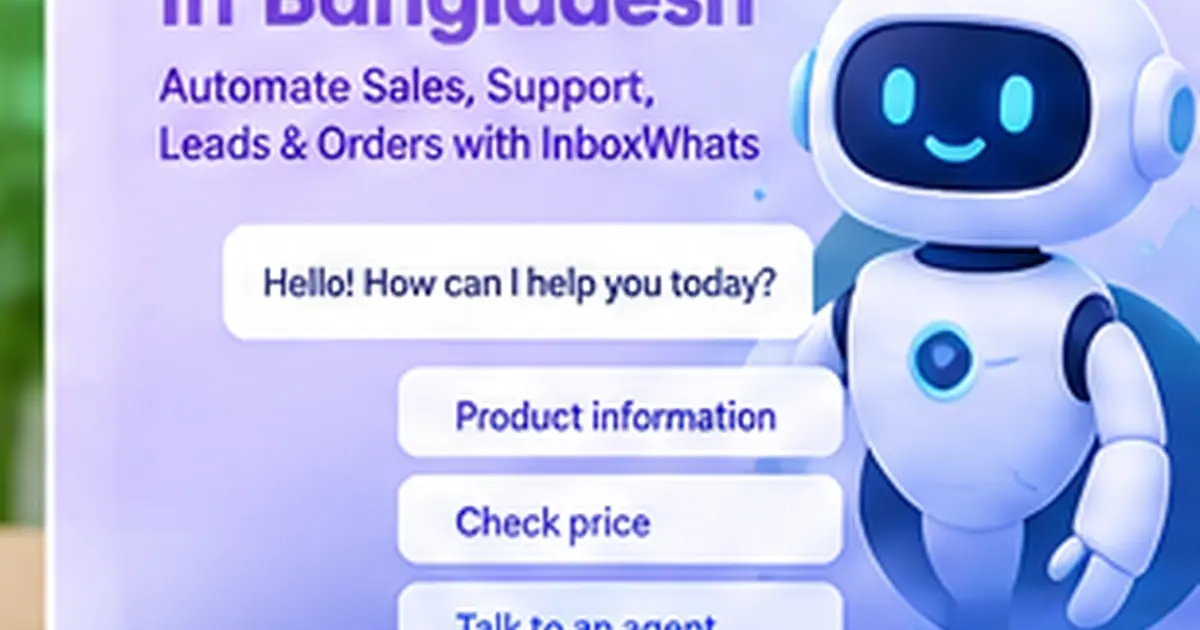
InboxWhats includes AI-assisted replies and an AI-supported flow builder alongside its omnichannel inbox and automation features.
Businesses can combine AI with structured flows.
For example, AI may understand the question, while a workflow can decide what to do next.
A customer asking about a product might receive product information first. If purchase intent is detected, the automation can begin collecting order details. If the customer has a complaint, the system can route the conversation to an agent.
Why AI Is Useful for Bangla and Banglish Conversations
Bangladeshi customers frequently mix Bangla and English.
A typical message might be:
"vai eta available? Dhakar baire delivery hobe?"
A rigid chatbot may only understand predefined words.
A language-capable AI model can often understand the meaning of natural messages more effectively. The quality still depends on the model, prompts, product data and workflow design, so businesses should test their own common customer messages before going live.
AI for Customer Support
A large share of support questions are repetitive.
Examples include:
- office location
- service hours
- delivery time
- payment methods
- course duration
- product availability
- registration process
- return or support procedure
AI can answer these common questions quickly when the correct information is available.
For sensitive, complicated or unusual cases, the customer should be able to reach a human agent.
AI for Lead Collection
A business does not always need to ask every lead the same questions manually.
An AI-supported workflow can collect:
- name
- phone number
- business type
- interested service
- budget
- location
- expected start date
- additional requirement
The sales team then receives a more useful lead rather than an empty inquiry.
AI for Lead Qualification
Lead qualification helps identify which inquiries need immediate sales attention.
For example, a software company may qualify a lead based on project type, budget and timeline.
An educational institute may qualify a student based on course interest, preferred batch and readiness to enroll.
An e-commerce business may identify a customer who is ready to order.
AI can help understand the conversation, while business rules should determine how the lead is categorized.
AI for Order Collection
A chatbot can guide the customer through an order flow.
Example:
Customer: I want the black one.
AI/Automation: Which size would you like?
Customer: XL.
AI/Automation: Please provide your name, phone number and delivery address.
Once the required fields are collected, the order data can move into the next workflow.
The final implementation depends on the business's order system and integrations.
AI Should Know When to Stop
One of the most important chatbot rules is knowing when a human should take over.
AI should not keep forcing automated replies when:
- the customer specifically asks for a person
- the question is outside available information
- a complaint is sensitive
- pricing requires negotiation
- the customer is angry or confused
- payment or account-specific investigation is required
A good automation design includes a clear human handoff.
AI + Rules Is Better Than AI Alone
Businesses can reduce unnecessary AI usage by combining deterministic automation with AI.
Simple messages such as "hi", "hello", business hours or a menu request may be handled with predefined logic.
AI can be used when natural-language understanding is actually needed.
This approach can make the system more predictable and can also reduce AI usage costs.
AI Chatbot for E-commerce
For e-commerce, AI can help answer:
- price
- color
- size
- stock
- delivery
- COD availability
- product differences
- order questions
Once buying intent is clear, automation can collect the details required for the order.
AI Chatbot for Education
Training centers and educational institutes can use AI to answer:
- course fee
- duration
- batch schedule
- online/offline availability
- registration process
- class location
The chatbot can then collect prospective-student information for the admission team.
AI Chatbot for Service Companies
Service businesses can use AI as the first layer of qualification.
A customer may explain a requirement in natural language. The chatbot can ask follow-up questions and structure the information before assigning the conversation to sales or support.
AI Chatbot and Omnichannel Customer Service
Customers may contact the same business through different channels.
InboxWhats publicly lists WhatsApp, Instagram, Messenger and Telegram as supported communication channels.
Bringing supported channels into one workspace can help a business apply consistent automation and team workflows instead of managing every platform separately.
How to Prepare Your Business Before Launching AI
Before enabling AI, prepare:
1. Accurate product and service information
2. Pricing rules
3. Delivery or service policies
4. Common FAQs
5. Escalation rules
6. Lead fields
7. Order fields
8. Human-agent routing rules
9. Clear prohibited responses
10. A testing set based on real customer messages
AI quality depends heavily on the information and rules you give it.
Is AI Chatbot Right for Your Business?
An AI chatbot is most useful when your business receives repeated customer questions or needs to collect structured information from many conversations.
It should support the team, not create another layer of confusion.
For businesses searching for an **AI chatbot for business in Bangladesh**, InboxWhats combines AI assistance with automation, team inbox features and integration options inside one communication platform.
Frequently Asked Questions
Can an AI chatbot understand Bangla?
Modern AI models can often understand Bangla and mixed Bangla-English messages, but businesses should test the exact model and their common customer language before relying on it.
Can AI collect customer orders?
Yes, when connected to a structured workflow, AI and automation can collect the information required for an order.
Can AI create leads automatically?
A chatbot can collect lead information and pass it to a CRM or lead workflow when the required integration is configured.
Can a human agent take over?
A well-designed business chatbot should include a direct human handoff path.
Does InboxWhats include AI?
InboxWhats publicly lists AI replies, AI-generated flows and AI-assisted automation features.