

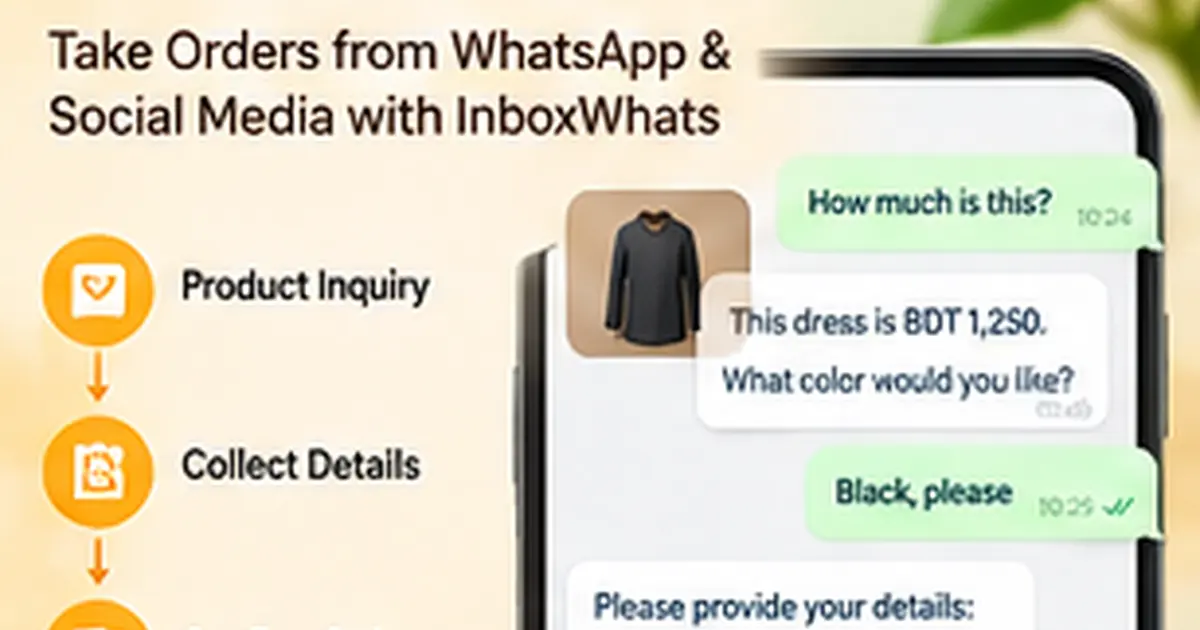
Many online businesses still collect orders manually.
An employee asks for the product, color, size, quantity, name, phone number and address. The same questions are repeated hundreds of times.
This process works at small volume, but it becomes expensive and inconsistent as the business grows.
An AI chatbot for order collection can automate the repetitive part while keeping a human available when needed.
What Does Automatic Order Collection Mean?
Automatic order collection does not simply mean answering "yes" when a customer asks whether a product is available.
A complete order flow should collect the information the business actually needs.
For example:
- Product
- Variation or SKU
- Size
- Color
- Quantity
- Customer name
- Phone number
- Delivery address
- Delivery area
- Special instruction
The system can then pass the structured information into the next order process.
Example Customer Conversation
Customer: Is the black shirt available?
AI: Yes. Which size would you like?
Customer: XL.
AI: Great. How many would you like?
Customer: 2.
AI: Please send your name, phone number and delivery address.
After the required information is collected, automation can confirm the details and hand the order to an agent or connected order system.
Why AI Helps
Customers do not always follow a fixed menu.
A customer may write:
"black xl 2ta lagbe rangpur pathaben"
AI can help interpret this natural message and identify that the customer wants two black XL items delivered to Rangpur.
The business should still validate required fields and product rules before confirming the order.
AI + Structured Flow
The safest design is usually a combination of AI and rules.
AI can understand intent and natural language.
Structured automation can ensure the required fields are collected.
For example:
AI identifies product intent → workflow checks missing fields → system collects details → order is reviewed or created
This avoids relying on free-form AI for every operational decision.
Use InboxWhats for Order Workflows
InboxWhats includes AI assistance, a visual flow builder, forms, APIs and webhooks.
These features can be combined to build order-oriented workflows.
The exact order creation step depends on the e-commerce, CRM or order-management system used by the business.
Order Collection from WhatsApp
WhatsApp is especially suitable for conversational ordering because customers are already comfortable asking questions before buying.
A business can use automation to answer:
- price
- stock
- color
- size
- delivery
- cash-on-delivery policy
- product details
When the customer is ready, the flow can begin collecting order data.
Order Collection from Other Supported Channels
InboxWhats also lists Instagram, Messenger and Telegram among its supported inbox channels.
Businesses can centralize conversations from these channels and apply a more consistent order-handling process.
Reduce Repetitive Agent Work
Without automation, an agent may spend a large part of the day typing the same questions.
Automation can handle the repetitive data-collection stage.
Agents can focus on:
- unusual requirements
- high-value orders
- complaints
- upselling
- failed payments
- complex product advice
Prevent Incomplete Orders
Manual chat orders often miss important information.
A structured flow can check whether required fields are present before moving to the next step.
For example, do not mark an order ready until:
- phone number is present
- address is complete
- product is identified
- quantity is known
This can improve operational consistency.
Confirmation Before Final Submission
A useful automation pattern is to show the order summary before final confirmation.
Example:
Product: Premium Shirt
Size: XL
Color: Black
Quantity: 2
Delivery: Rangpur
Phone: 01XXXXXXXXX
Then ask:
Is this information correct?
This gives the customer a chance to fix mistakes.
Connect to CRM, ERP or E-commerce Software
InboxWhats provides APIs and webhooks that can be used for external integrations.
Depending on the business system, the collected order may be sent to:
- e-commerce backend
- CRM
- ERP
- delivery system
- custom order database
- Google Sheet
- internal dashboard
The integration should be designed around the company's actual order process.
Human Review When Needed
Not every order should be fully automated.
Human review may be useful for:
- large orders
- custom products
- unusual delivery areas
- high-risk COD orders
- pricing exceptions
- incomplete information
Automation should support the team rather than remove necessary controls.
AI Order Collection for Bangladesh E-commerce
Bangladesh has a large social-commerce market where businesses sell through Facebook, Instagram and WhatsApp conversations.
For these businesses, conversational order collection can reduce manual work and help organize customer information.
The system can be configured around local needs such as district, area, COD preference and delivery instructions.
Frequently Asked Questions
Can an AI chatbot take orders on WhatsApp?
Yes. With a structured workflow, AI and automation can collect the information required for an order.
Can the chatbot understand natural customer messages?
AI can interpret many natural-language messages, but businesses should validate important data before creating an order.
Can orders go directly to another software?
Yes, if the required API or webhook integration is available and configured.
Can an agent take over the chat?
Yes. Human handoff should be part of the workflow for complex cases.
Is this useful for Facebook-based e-commerce?
It can be especially useful for social-commerce businesses that receive large numbers of repetitive product and order inquiries.